
Why we say “enriched” out loud
Because the alternative is a parent working out halfway through the bag that the emerald in a Brunswick County creek bed is unlikely, and then wondering what else they have been told. We would rather hand you the truth with the screen.
North Carolina genuinely is one of the great mineral states, the only place on earth where all four precious gemstones have been found, which is a fact the state geological survey is quietly proud of. Hiddenite, emerald, sapphire and ruby all come out of the Carolina terrane up in the piedmont and the mountains. None of it comes out of the sand down here, because down here is a coastal plain made of marine sediment. What the coastal plain gives you instead is fossils, and it gives you an enormous number of them.
What gem mining actually puts in the bag
The gem bag
Amethyst in the pale lilac you would expect and occasionally something darker. Quartz, clear, rose, smoky, and a milky white that children reliably mistake for a diamond and should be allowed to for at least ten minutes. Garnet, in deep red, usually small and usually plentiful. Pyrite, which is the best-value stone in the bag because of the look on a face. Emerald and sapphire in small pieces, rough rather than cut. Tiger’s eye, aventurine, jasper and agate turn up as well.
The fossil bag
Shark teeth, mostly, and this is where it gets properly interesting. The teeth that come out of Carolina spoil material are real fossils from real sharks that swam over what is now Interstate 40. Sand tiger teeth are the common ones, narrow, hooked, with a little cusp either side. Lemon and mako turn up. Occasionally there is a megalodon fragment, and a whole one is the sort of thing that gets photographed on the camp store counter.
Beyond teeth, there are ray dental plates, vertebrae, bits of coral and the odd piece of petrified wood.
How to work a sluice without losing the good bits
This is the part nobody explains, and it is the difference between a full screen and a disappointed child.
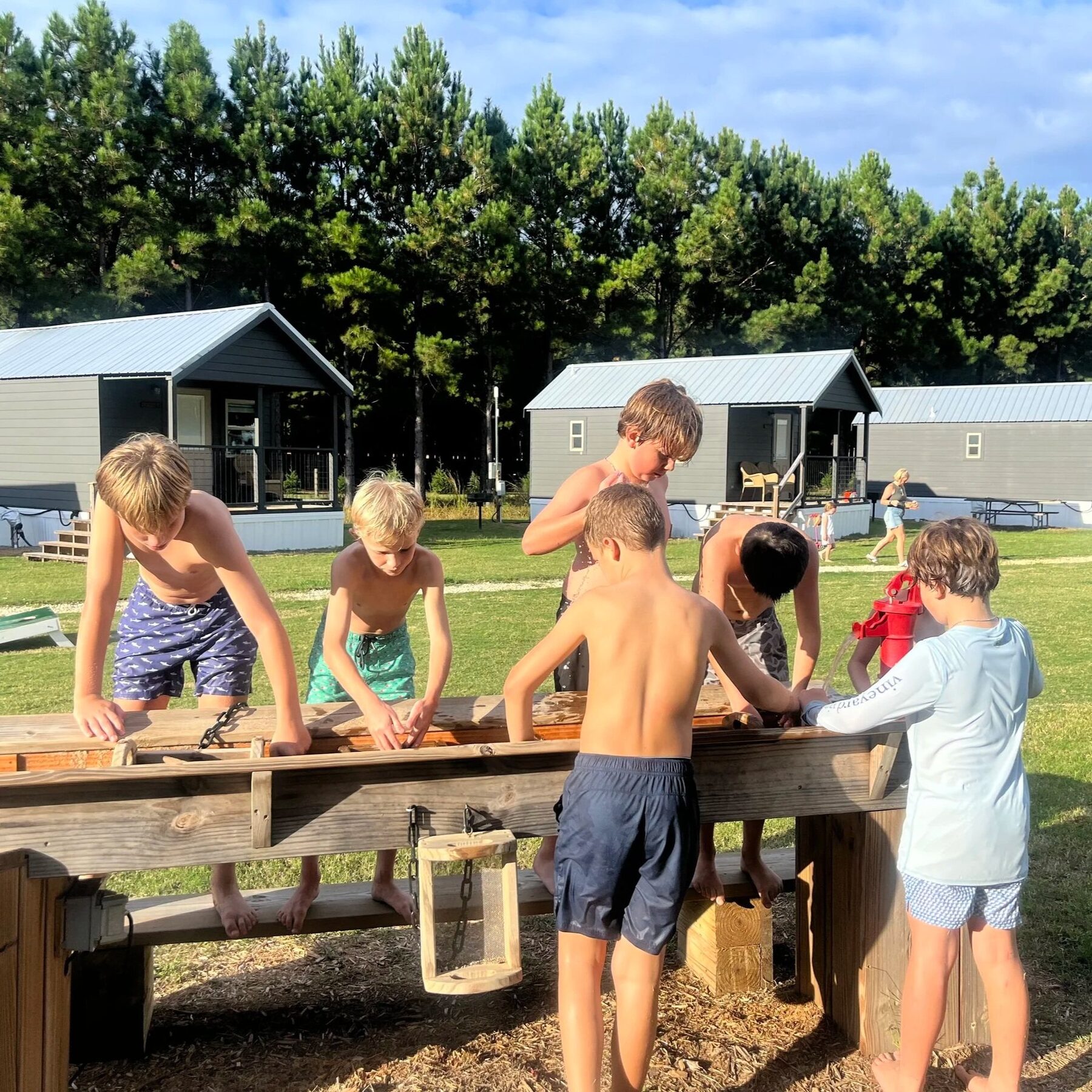
Load the screen about a third full. Not more: a loaded screen is a heavy screen, and a heavy screen gets tipped. Lower it flat into the running water and let the current do the work for a few seconds before you touch anything. Then shake side to side, not back and front, and keep the frame level. The moment you tilt it, the small dense things, which is to say the garnets and the teeth, go over the downstream edge and into the trough, and you will never know they were there.
When the water runs clear through the screen, lift it out, tip the whole thing onto a towel, and look at it dry. Wet dirt hides everything. Half the finds in a bag show up on the towel rather than in the water.
What the children are actually learning
More than you would think. A shark tooth is a real object from a real animal with a real age attached to it, and the jump from “shiny thing” to “this was alive” happens in front of you, usually around age six. The identification chart on the wall of the mining shed does a lot of the work; the rest is somebody holding a tooth up to the light and asking how old.
It is also, bluntly, a very good forty minutes of an August afternoon when the pool is full and nobody wants to get back in the car.
Practical things
Mining runs every day from 9 AM to 5 PM. The sluice sits in the open air with no cover over it yet, so pick a dry afternoon and bring a hat if the sun is out. You do not need to be staying with us: the sluice is open to the public as well as to campers, and a lot of people drive out for an afternoon. Groups should ring ahead on 910.845.5040 so there are enough bags and enough hands.
Start with the treasure hunt
Most children arrive at the sluice by way of Blackbeard’s Lost Treasure Hunt. Pick up a map at the camp store, follow the clues along the walking trails, and whoever finds the stash brings it back and trades it for a small bag of gemstones, free. Plenty of them then buy a bigger bag and keep going, which is how a half-hour walk in the pines turns into an afternoon at the trough.
Where to take it from here
If the fossils are the hook, the Carolina coast will keep feeding it. The beaches at Oak Island and Caswell give up teeth after a storm, especially on the low tide after a blow from the east. The North Carolina Aquarium at Fort Fisher has the context. And the creeks and spoil banks of Brunswick County are, geologically speaking, exactly the same thing as your bag, just unsorted and a great deal muddier.
The sluice runs 9 to 5, every day
Campers and the public alike. Stay the night under the pines while you are at it. There are full-hookup RV sites and cabins on the same forty acres.